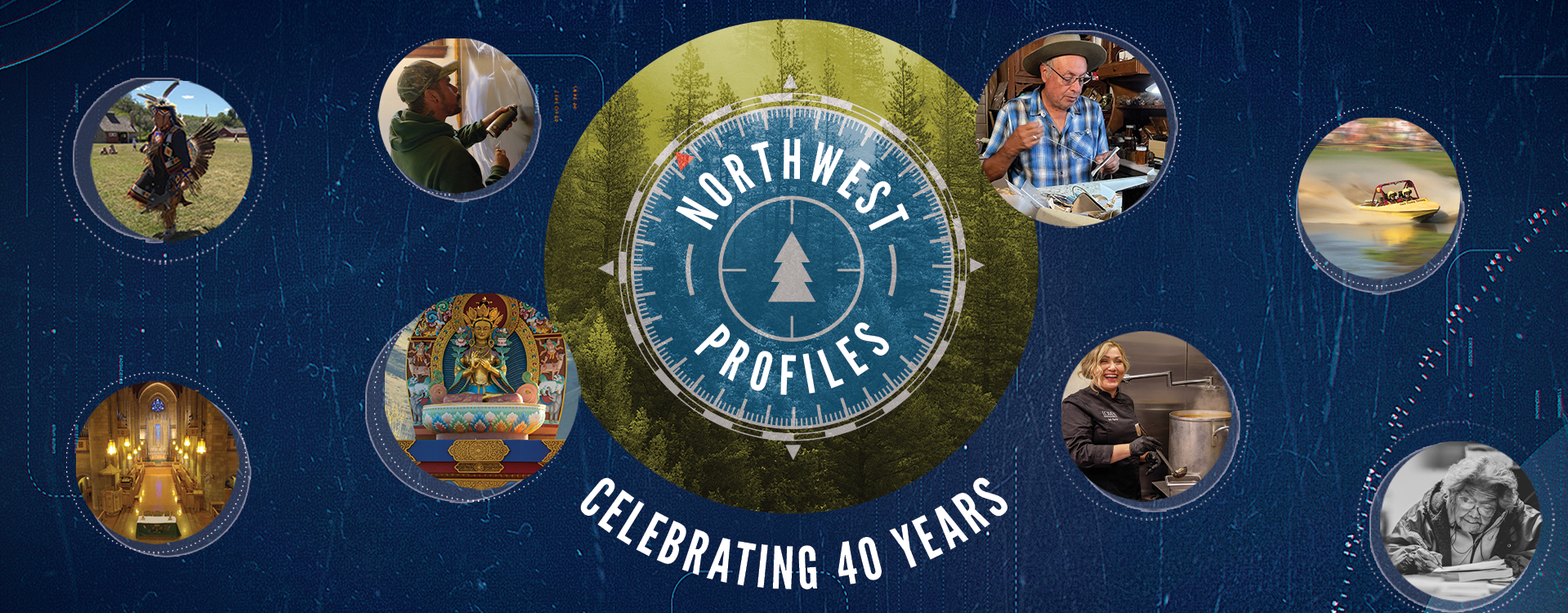
KSPS PBS’s flagship program, Northwest Profiles, will kick off its 40th season this fall, building on a legacy that now includes over 750 stories about regional artists, makers and community voices.
Season 40 premieres on Thursday, October 29 at 7 p.m. PT on KSPS PBS, with episodes airing monthly through May. The program is also available at ksps.org and on the PBS App. Each episode includes four unique story segments from KSPS PBS’s broadcast region which spans eastern Washington, northern Idaho, Alberta and southeastern British Columbia.
The 40th anniversary takes on special importance as it comes just one year after Congress voted to eliminate federal funding for public media. The rescission of federal funding left KSPS PBS with a $1.2 million loss in annual funding, about 18% of the station’s annual income. However, after a challenging, unprecedented year, KSPS PBS has adapted its business model with strong community support. The station remains committed to continuing to invest in local storytelling.
Jim Zimmer, executive producer at KSPS PBS, has been on staff for Northwest Profile’s entire 40-year run, leading a program that’s adapted to changes in the media landscape, while still staying true to its roots.
“It’s about our community and our neighbors,” says Zimmer. “That’s what’s guided us all this time. The people we profile aren’t necessarily famous, but they’re doing something special that uplifts others. We’ve profiled musicians, nonprofit leaders, artists, magicians – you name it. Sharing these stories connects us to one another.”
“Forty seasons of Northwest Profiles says something important about what public media can do that few other institutions can: Stay rooted in a community long enough to tell its stories across generations,” said Skyler Reep, President & General Manager of KSPS PBS. “After everything public media has been through over the past year, reaching this milestone feels especially meaningful. Our community has made it clear that local storytelling matters, and we intend to keep investing in it.”
Reaching New Audiences in the Digital Age
Northwest Profiles has evolved along with its viewing audience and now has a rich presence on YouTube, Instagram and Facebook. On these platforms, the program has received an outpouring of support from community members excited to see distinctive, local stories.
The KSPS PBS production team breaks each story segment into two or three vertical videos designed for social media platforms – enabling the same community-first stories that have guided Northwest Profiles for forty years to reach new audiences of all ages.
Since Jan. 1, 2026, Northwest Profiles posts have received 359,927 impressions on Facebook and Instagram. The posts have received hundreds of comments, with many viewers sharing personal connections with the story subjects and others expressing their enthusiasm about discovering something new in their region.
Reflecting on a Rich History
This season, in addition to a slate of new profiles, each episode will include a retrospective on an older story interspersed with an interview of the producer who made it. In addition to Jim Zimmer, KSPS PBS producer Scott McKinnon has also been on staff for the program’s entire 40-year history. Other founding members of the program, including Lynn Veltrie and Bob Lawrence, will be interviewed as well.
Northwest Profiles was originally created by Bill Stanley, who worked at KSPS PBS for nearly forty years, serving in various roles from producer and director to station manager. The segments were first designed to be used as interstitials to fill the gaps between programs before evolving into a half-hour show.
Zimmer’s adventures with Northwest Profiles have taken him soaring through the sky with aviator Gladys Buroker, shooting down a luge track with the Calgary Winter Olympics and gliding through the air with the Walla Walla Hot Air Balloon Stampede.
“As a filmmaker, it’s a great gift to be given the time to develop stories like this,” says Zimmer. “Especially at a time when so many television stations are joining large conglomerates and cutting budgets, our model as a community-funded, public media station makes this work uniquely possible.”